

 Photo Credit:Andrew Benge / Contributor / Getty Images)
British Nigerian artist Nnena Kalu has achieved a landmark victory in contemporary art by becoming the first learning disabled artist to win the prestigious Turner Prize. Her win marks a transformative moment in an art world that historically overlooked her talent, despite her decades of dedication to sculpture and drawing. The honor places her alongside celebrated past winners including Damien Hirst, Steve McQueen and Anish Kapoor, reaffirming the significance of her contributions.
Kalu, who was born in Glasgow and lives with autism and limited verbal communication, received the award during a ceremony in Bradford. She was joined on stage by representatives from ActionSpace, a London based charity where she has been a resident artist for more than twenty five years. Speaking on her behalf, Charlotte Hollinshead described Kalu’s achievement as the result of long standing perseverance. Hollinshead emphasized that Kalu worked for years without recognition and endured discrimination that limited opportunities available to her.
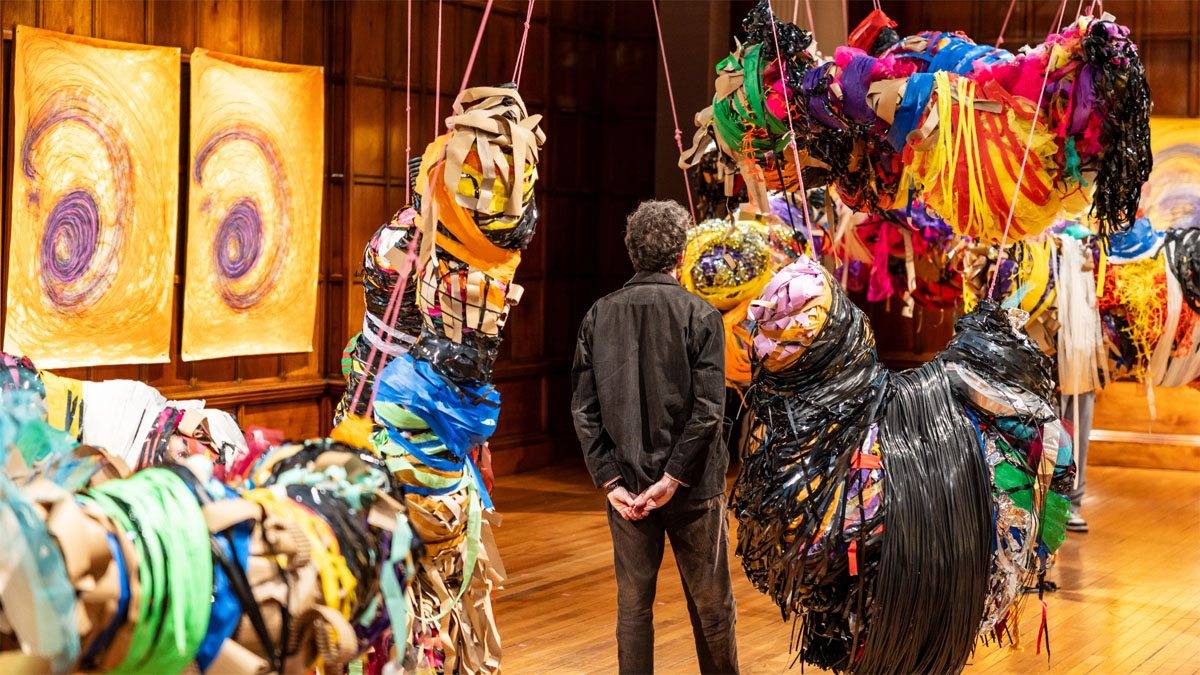
Kalu began her artistic journey producing two dimensional works but shifted toward her signature sculptures about fifteen years ago. These pieces often begin as tubular or cocoon like bundles made of textiles, paper and cellophane. She builds them through repetitive wrapping and layering, incorporating ropes, fabrics and magnetic tape. Her process creates large draped forms that express movement, tension and emotional intensity.
Around 2013 she introduced circular drawings that resemble vortexes of ink, graphite and acrylic. These whirlpool compositions are often displayed in pairs or triptychs and have become central to her practice. The Turner Prize recognized both her work “Drawing 21” and her sculptural series “Hanging Sculpture 1 to 10,” showcased in exhibitions in Liverpool and Barcelona.
The jury described her work as bold, compelling and marked by a mastery of scale and color. Despite beginning her career in the late 1990s, her commercial breakthrough only came after a 2023 exhibition at Arcadia Missa in London. The gallery praised her win as a moment that will influence artistic discourse for years to come.
Kalu received USD 33,000 for the award, while the other shortlisted artists each received USD 13,000. Her nomination was described by curator Lisa Slominski as a watershed moment that expands representation in major institutions. While acknowledging her disability, Slominski stressed that her work must be appreciated beyond that lens. Kalu’s win solidifies her place among influential contemporary artists and marks a significant shift toward greater inclusivity within the art world.